Thursday, April 14, 2011
How to save a trillion dollars... better food?
A co-worker just sent out this article and I thought it was worthy of passing along. Demonstrates the importance of prevention, and how we could easily save that $38 billion Congress insists on cutting just by investing in Americans eating better! http://opinionator.blogs.nytimes.com/2011/04/12/how-to-save-a-trillion-dollars/?nl=todaysheadlines&emc=thab1

Wednesday, March 23, 2011
Hippocrates Soup
I just finished reading the Gerson Therapy book and was inspired to make Hippocrates Soup. Every Gerson patient is supposed to eat this every day for lunch.
Here's a cool youtube video that shows how to make it: http://www.youtube.com/watch?v=dB0FaWXt0Mo
And here is a picture of mine today (I didn't put it through a food mill):
2. Wash and scrub them well.
3. Cut them coarsely.
4. Put veggies in a 4-quart stainless steel pot and cover with distilled water.
5. Simmer them slowly for 2 hours.
6. Put them through a food mill in small portions. Only the fibers should be left.
Keep well covered in refrigerator no longer than 2 days. Warm up as much as needed each time (not in the microwave though!). Do not add salt - this is bad for your body because it inhibits Potassium (K) absorption or something like that.
Good stuff!
-Andi
Here's a cool youtube video that shows how to make it: http://www.youtube.com/watch?v=dB0FaWXt0Mo
And here is a picture of mine today (I didn't put it through a food mill):

- 1 medium celery knob or 3-4 stalks celery
- 1 medium parsley root
- Garlic as desired
- 2 small leeks
- 1.5 lbs. tomatoes
- 2 medium onions
- 1 pound of potatoes
- A little parsley
2. Wash and scrub them well.
3. Cut them coarsely.
4. Put veggies in a 4-quart stainless steel pot and cover with distilled water.
5. Simmer them slowly for 2 hours.
6. Put them through a food mill in small portions. Only the fibers should be left.
Keep well covered in refrigerator no longer than 2 days. Warm up as much as needed each time (not in the microwave though!). Do not add salt - this is bad for your body because it inhibits Potassium (K) absorption or something like that.
Good stuff!
-Andi
Saturday, February 19, 2011
Norwalk Juicers & the Gerson Therapy
I'm about 1/3 of the way through the book, "The Gerson Therapy: The Proven Nutritional Program For Cancer and Other Illnesses."
Apparently Dr. Gerson recommends the Norwalk Juicers. The things aren't cheap though - $2,495 and it's yours! Good thing my birthday is coming up ;-)
This book has some interesting points, though, which have some similar findings to the Paleo Diet. It sounds to me like Dr. Gerson recommends doing his (vegan, mostly organic fruits and veggies) diet 75% of the time, with room for you to eat whatever you want the other 25% of the time if you are basically healthy. So my thinking is it could essentially be very much like the Paleo Diet if you ate 75% fruits and veggies and 25% lean meat. The key being, lots of organic fruits and veggies help your body charge up, repair and rebuild its cells.
Apparently Dr. Gerson recommends the Norwalk Juicers. The things aren't cheap though - $2,495 and it's yours! Good thing my birthday is coming up ;-)
This book has some interesting points, though, which have some similar findings to the Paleo Diet. It sounds to me like Dr. Gerson recommends doing his (vegan, mostly organic fruits and veggies) diet 75% of the time, with room for you to eat whatever you want the other 25% of the time if you are basically healthy. So my thinking is it could essentially be very much like the Paleo Diet if you ate 75% fruits and veggies and 25% lean meat. The key being, lots of organic fruits and veggies help your body charge up, repair and rebuild its cells.
Thursday, February 17, 2011
Back on the bandwagon!
I've been slacking on the Paleo Diet these past few months (and my sugars have been in the 300-400s!) but Mitch and I are going to start it again in full force next week.
MONDAY, FEBRUARY 21 is the big "start again" day.
The one modification I am going to make is to try not to eat as much animal protein, and to eat more veggies instead.
MONDAY, FEBRUARY 21 is the big "start again" day.
The one modification I am going to make is to try not to eat as much animal protein, and to eat more veggies instead.
Saturday, January 15, 2011
Cures for cancer and the common cold!?
I watched the movie, A Beautiful Truth, recently (have you seen it? you should...). It is the story of a doctor named Max Gerson who found a cure for cancer: diet! Imagine that.
Here's a picture/link to it on amazon.com:

The movie also highlights some other natural health remedies, one of which is hydrogen peroxide. Apparently hydrogen peroxide can cure the common cold! And it can be used as a nontoxic cleaning solution (with vinegar) that gets rid of dangerous germs like Salmonella and E. coli better than conventional cleaning solutions you buy at the store! Here is a video where I talk about some of this stuff....
Here's a picture/link to it on amazon.com:
The movie also highlights some other natural health remedies, one of which is hydrogen peroxide. Apparently hydrogen peroxide can cure the common cold! And it can be used as a nontoxic cleaning solution (with vinegar) that gets rid of dangerous germs like Salmonella and E. coli better than conventional cleaning solutions you buy at the store! Here is a video where I talk about some of this stuff....
Thursday, January 13, 2011
Take the Green Smoothie 30 Day Challenge!

When I was home (in Michigan) for Christmas, my brother told me about this new thing he's been eating: green smoothies.
What is a green smoothie? It is basically a regular (fruit) smoothie with "greens" - i.e. spinach, kale, celery, wheatgrass, etc. - added to it. Upon first hearing about this, most people are disgusted by the thought (myself included). But my brother made me one when I was home and I was pleasantly surprised by the delicious taste! They really don't taste any different than a regular, fruit smoothie b/c the fruit masks the taste of the chlorophyll in the greens. It is a fantastic way for people who don't like the taste of things like spinach, kale, celery, wheatgrass, etc. to get the NECESSARY nutrients from these greens/veggies without having to "choke them down."
So, upon hearing of this, my roommates suggested we take the 30 day Green Smoothie Challenge. I am committed to eating at least one green smoothie everyday for the next 30 days.
Here is a link to the book on Amazon.com by Victoria Boutenko in case you might be interested (you can also click on the picture above). It's only 10 bucks and it includes over 200 recipes!
One of the biggest cautions about taking the 30 day green smoothie challenge (if you're not going to read up on it before starting) is to make sure you vary your greens! The reason for this is:
"Green leaves are typically the most nutritious part of a plant, and creatures naturally want to eat them. Plants carry a trace of alkaloids in their leaves to ensure that animals will move on to eat other green plants and will not exterminate any one species. Although alkaloids are poisonous in large quantities, in small quantities they cannot hurt you, and even strengthen the immune system. The science of homeopathy is based on this principle. However, if you keep consuming kale, or spinach, or any other single green for many weeks without rotation, eventually the same type of alkaloids can accumulate in your body and cause unwanted symptoms of poisoning. Most greens contain different kinds of alkaloids, which is why, by rotating the variety of greens in our smoothies, we can avoid poisoning and strengthen our immunity."
Victoria, the author of the book, discovered this when she ate kale for 3 months straight and her face started to go numb!! (wouldn't be my choice to find this out this way...)
So here is a summary of a few rules of thumb in case you want to join in on the 30 day green smoothie revolution:
- Rotate/vary your greens! (see above quote for explanation)
- Sip your green smoothie slowly, mixing it with saliva for better absorption.
- Don't add anything to your smoothie except greens, fruit, and water. Other things can slow down the assimilation of smoothies in your digestive tract and may cause irritation and gas.
- Drink your smoothie by itself, and not as part of a meal. You can eat anything you want approximately 40 minutes before or after your smoothie.
- Do not add starchy vegetables such as carrots, beets, broccoli stems, zucchini, cauliflower, cabbage, Brussels sprouts, eggplant, pumpkin, squash, okra, peas, corn, and green beans to your green smoothies. They combine poorly with fruit and cause gas.
- Don't add too many ingredients to one smoothie, such as 4 different fruits and 6 different greens. To keep things easy on your digestive system, try to keep most of your recipes simple to maximize nutritional benefits.
- Learn to prepare a really delicious green smoothie so that you are always looking forward to the next one.
- Choose organic produce whenever possible. The absence of pesticides and other toxic chemicals is only one of the many benefits of organic food. The most important reason to consume organic food is the superiour nutrition of organic fruits and vegetables in comparison to conventionally grown produce.
Got it? Let's get started! :)
Friday, October 22, 2010
The one nutritional rule of thumb we all can agree on
With all of the variety of nutrition books I have read and have been reading lately (i.e. The Paleo Diet, The China Study, Devil in the Milk, Omnivore's Dilemma, In Defense of Food, Diabetes Solution, etc...), I've gained a much broader knowledge of nutritional concepts and controversies out there.
The one bit of nutrition advice it seems like most everyone can agree on, though, is that it is best to make a majority of your diet organic, local fruits and vegetables.
From my limited experience and understanding, if a person can do this then they are 90% of the way to a healthy diet.
After this we all need to make a decision about consuming animal products (meat, dairy, eggs), grains, and legumes. My story so far points to the Paleo Diet working very well for me. But I'm in the process of re-examining my intake of animal products. I have a deep respect for those who go vegetarian or vegan for the sake of peace, the environment, and/or social justice.
The one bit of nutrition advice it seems like most everyone can agree on, though, is that it is best to make a majority of your diet organic, local fruits and vegetables.
From my limited experience and understanding, if a person can do this then they are 90% of the way to a healthy diet.
After this we all need to make a decision about consuming animal products (meat, dairy, eggs), grains, and legumes. My story so far points to the Paleo Diet working very well for me. But I'm in the process of re-examining my intake of animal products. I have a deep respect for those who go vegetarian or vegan for the sake of peace, the environment, and/or social justice.
Thursday, October 21, 2010
Why you haven't heard about the A1/A2 milk issue
This quote from the book "Devil in the Milk" by Keith Woodford, wonderfully summarizes why most people have not heard about the A1/A2 milk issue...
"One question that people often ask me is why should Fonterra [New Zealand's largest dairy co-operative that markets over 95% of New Zealand's dairy production and about 45% of the world's internationally traded dairy products: they produce/sell mostly A2 milk] oppose A2 milk? The reasons are complex but they are encapsulated in a quote from Warren Larsen on the Four Corners programme:
'There's one thing in marketing you always need to understand. You never do anything that destroys the category. Nothing. And in this case, that's precisely what the A2 Corporation, in my view, has done.'
Stripping aside the marketing jargon, what Larsen meant was that promoting A2 milk would have to be done in a way that did not destroy the overall market for milk. A2 milk would therefore need to be marketed in a way that did not cast doubts on A1 milk! Clearly that would be a challenge!
The reason Warren Larsen argued this way is that although it is not particularly difficult for farmers to change their herds over to being A2 milk producers, it does take time. In fact it takes about two cow generations of breeding, and this means about 10 years. The important point here in relation to 'destroying the category' is that while such a change in the herds is occurring, dairy companies such as Fonterra still have to sell a huge amount of A1 milk. So from a dairy company's perspective it would be much easier if A1 milk was a non-issue. And once A2 Corporation started arguing that A1 milk was a health issue, rather than just saying that A2 milk had special positive attributes, then the knives were out on both sides."
"One question that people often ask me is why should Fonterra [New Zealand's largest dairy co-operative that markets over 95% of New Zealand's dairy production and about 45% of the world's internationally traded dairy products: they produce/sell mostly A2 milk] oppose A2 milk? The reasons are complex but they are encapsulated in a quote from Warren Larsen on the Four Corners programme:
'There's one thing in marketing you always need to understand. You never do anything that destroys the category. Nothing. And in this case, that's precisely what the A2 Corporation, in my view, has done.'
Stripping aside the marketing jargon, what Larsen meant was that promoting A2 milk would have to be done in a way that did not destroy the overall market for milk. A2 milk would therefore need to be marketed in a way that did not cast doubts on A1 milk! Clearly that would be a challenge!
The reason Warren Larsen argued this way is that although it is not particularly difficult for farmers to change their herds over to being A2 milk producers, it does take time. In fact it takes about two cow generations of breeding, and this means about 10 years. The important point here in relation to 'destroying the category' is that while such a change in the herds is occurring, dairy companies such as Fonterra still have to sell a huge amount of A1 milk. So from a dairy company's perspective it would be much easier if A1 milk was a non-issue. And once A2 Corporation started arguing that A1 milk was a health issue, rather than just saying that A2 milk had special positive attributes, then the knives were out on both sides."
Monday, October 18, 2010
Type 1 diabetes caused by A1 milk?!?!
A few days ago I typed in "type 1 diabetes and dairy" into a Google search, just to see what might come up.
Since I've discovered my body feels SOOOOOOO much better when I don't drink/eat dairy products, I was lactose intolerant as a kid, and I've heard rumblings of clinical studies on cows milk causing type 1 diabetes, I've had a nagging suspicion for a couple years now that dairy is related to my endocrine plight.
Well, here's an article that came up that has me fired up!!!!: Why some dairy causes heart disease and diabetes and some doesn't
This article explains how dairy with the A1 beta-casein protein (as opposed to dairy with the A2 beta-casein protein) is linked to causing type 1 diabetes! ...as well as heart disease, autism, and schizophrenia.
I wanted to know more about this, so I ordered the book "Devil in the Milk: Illness, Health, and the Politics of A1 and A2 Milk" from Amazon.com and started reading it today (click on the link or pic below to learn more).

The more I learn about the wicked web of health and politics and money, the more I am discouraged. And I have started writing songs about this - my first song being about the dairy industry. People need to know about how the truth gets swept under the rug when money and powerful corporations get involved. It breaks my heart.
So... a huge passion of mine is figuring out ways to align incentives with doing good. How can we align incentives such that dairy farmers make their cows into A2 cows that produce A2 milk?
Since I've discovered my body feels SOOOOOOO much better when I don't drink/eat dairy products, I was lactose intolerant as a kid, and I've heard rumblings of clinical studies on cows milk causing type 1 diabetes, I've had a nagging suspicion for a couple years now that dairy is related to my endocrine plight.
Well, here's an article that came up that has me fired up!!!!: Why some dairy causes heart disease and diabetes and some doesn't
This article explains how dairy with the A1 beta-casein protein (as opposed to dairy with the A2 beta-casein protein) is linked to causing type 1 diabetes! ...as well as heart disease, autism, and schizophrenia.
I wanted to know more about this, so I ordered the book "Devil in the Milk: Illness, Health, and the Politics of A1 and A2 Milk" from Amazon.com and started reading it today (click on the link or pic below to learn more).
The more I learn about the wicked web of health and politics and money, the more I am discouraged. And I have started writing songs about this - my first song being about the dairy industry. People need to know about how the truth gets swept under the rug when money and powerful corporations get involved. It breaks my heart.
So... a huge passion of mine is figuring out ways to align incentives with doing good. How can we align incentives such that dairy farmers make their cows into A2 cows that produce A2 milk?
Thursday, October 14, 2010
New Paleo Cookbook by Loren Cordain!
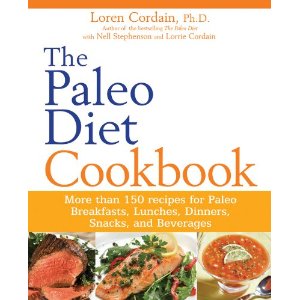
Great news! Loren Cordain, the guy who wrote "The Paleo Diet" is coming out with a cookbook! This is great news because the only cookbooks I've been able to find are online ones that I had to print out myself (which is super expensive!).
You can pre-order Dr. Cordain's book on Amazon. (click on that link to do so! I just did!) And it only costs $13!
Thursday, October 07, 2010
No cavities!!!
For the past few years I have had cavities every single time I went into the dentist. Well, good news: I went to the dentist this week and no cavities since going Paleo!!!
The Paleo Diet 101
I made a "cheat sheet" for some friends who were interested in trying the Paleo Diet. Here are the basics and some helpful hints from my own journey.
-Andi
The Paleo Diet 101
NO:
- dairy (i.e. milk, cheese, ice cream, yogurt)
- grains (i.e. wheat, corn, rice)
- legumes (i.e. beans, soy, peanuts, chick peas)
- salt or sugar
YES:
- veggies
- fruits
- lean protein (i.e. meat, eggs, seafood)
- nuts
- seeds
OK OCCASIONALLY (from my experience, not technically Paleo):
- fermented foods (i.e. pickles, tofu, beer)
- potatoes (sweet potatoes are better than regular potatoes)
- ezekiel 4:9 tortillas/bread (try to limit to no more than 1-2 per week)
GOOD SUBSTITUTES:
- dairy: almond milk, coconut ice cream
- grains: zucchini spaghetti, spaghetti squash, almond meal
- legumes: almond butter (instead of PB), nuts
- salt: spices (i.e. onion powder, garlic powder)
- sugar: honey, agave nectar
HELPFUL HINTS:
- TREND your eating toward Paleo. Keep in mind it is pretty much impossible to go all Paleo this day in age. Don't beat yourself up if you slip up and eat something you're not supposed to. Try to limit non-Paleo meals to 3 or less per week, though, to get the full benefits.
- find good substitutes for foods you like to eat. This will help you stick to the diet.
-Andi
The Paleo Diet 101
NO:
- dairy (i.e. milk, cheese, ice cream, yogurt)
- grains (i.e. wheat, corn, rice)
- legumes (i.e. beans, soy, peanuts, chick peas)
- salt or sugar
YES:
- veggies
- fruits
- lean protein (i.e. meat, eggs, seafood)
- nuts
- seeds
OK OCCASIONALLY (from my experience, not technically Paleo):
- fermented foods (i.e. pickles, tofu, beer)
- potatoes (sweet potatoes are better than regular potatoes)
- ezekiel 4:9 tortillas/bread (try to limit to no more than 1-2 per week)
GOOD SUBSTITUTES:
- dairy: almond milk, coconut ice cream
- grains: zucchini spaghetti, spaghetti squash, almond meal
- legumes: almond butter (instead of PB), nuts
- salt: spices (i.e. onion powder, garlic powder)
- sugar: honey, agave nectar
HELPFUL HINTS:
- TREND your eating toward Paleo. Keep in mind it is pretty much impossible to go all Paleo this day in age. Don't beat yourself up if you slip up and eat something you're not supposed to. Try to limit non-Paleo meals to 3 or less per week, though, to get the full benefits.
- find good substitutes for foods you like to eat. This will help you stick to the diet.
Thursday, September 23, 2010
The great thing about soup...

Check out the lunch I ate yesterday! I used up almost all of the veggies we got from our CSA to make the "Fall Harvest Soup" and the only thing un-Paleo about it is the small can of blackeyed peas in it (and a little salt). What a great way to use up all the fennel we've been getting! And the great thing about soup is that you can throw so many ingredients in it and it still (usually) tastes good!
The carrots are a new fave of mine: steamed carrots with fresh dill and a little bit of honey on top.
Zucchini was just sauteed in a little olive oil.
Someone at work commented on how small my apple was. That has been a new joy for me: discovering the size that fruit is "meant to be." I no longer eat chemical laden apples on steroids. And something I have discovered is that most fruit (i.e. peaches, apples, pears, plums) from our organic farm never has much more than 15 grams of carbohydrate in it. Compare this to a conventional apple at the store, which usually has around 30 grams of carbohydrate in it. I don't think we were meant to eat that many carbs in one piece of fruit....
The dessert you see is from a Paleo cookbook I got online. It helped me use up all the pears we got in our CSA share last week. Basically it is just pears, a bag of frozen blueberries, almond meal, and a little honey/agave nectar. As well as some spices like nutmeg and cinnamon. Yum!
The avocado was me "cheating" - they were on sale at the store and I couldn't resist.
Went to my acupuncture appt. yesterday and was told that this diet has been a great thing for my overall health and digestion. I couldn't agree more!
Tuesday, September 07, 2010
Food, Inc. and The China Study
Last night was a big "food" night for me. I watched the movie "Food, Inc." and started the book "The China Study." If you've never heard of either of these things, here is a little synopsis.
Food, Inc. (<-- click on that link!) is a documentary-type movie about the food industry. It shows the "dark side" of where our food comes from and how it is produced nowadays. It interviews people such as Michael Pollan (author of The Omnivore's Dillema) and Joel Salatin (Polyface Farms), and advocates eating local, organic food. It was great to watch with one of my roommates who may be inheriting a family farm soon and actually have the opportunity to do it right. The one gripe I had about this movie was that it was too serious - I wish they would have injected a little more humor into it. But it is very informative and inspiring! I was so happy to be a part of a (local, organic) CSA after watching it. Next challenge: figure out how to help people who can't afford to eat like this be able to eat like this. SAME Cafe seems to be doing a good job of this - I need to visit that place soon!
The China Study is a little more controversial for me. So far I've only read the first chapter and some strong claims have been made that essentially a vegan diet (no meat, dairy, eggs) can reverse and cure things like heart disease, diabetes, and cancer. I really want to believe that a vegan diet is the way to go b/c I don't like killing animals for food (and I am trying more and more to figure out how to bring peace to the world in every way possible), but one question pops to mind in response to his claims - which makes me less apt to believe his findings fully: why did the eskimoes have low rates of heart disease on a diet of mostly all seal meat? (I know the omega-3 to omega-6 ratio is good in seal meat...) I do, however, believe that the author, T. Colin Campbell, has something very right: more fruits and veggies make for healthier people. Looking forward to hearing what else he has to say.
Food, Inc. (<-- click on that link!) is a documentary-type movie about the food industry. It shows the "dark side" of where our food comes from and how it is produced nowadays. It interviews people such as Michael Pollan (author of The Omnivore's Dillema) and Joel Salatin (Polyface Farms), and advocates eating local, organic food. It was great to watch with one of my roommates who may be inheriting a family farm soon and actually have the opportunity to do it right. The one gripe I had about this movie was that it was too serious - I wish they would have injected a little more humor into it. But it is very informative and inspiring! I was so happy to be a part of a (local, organic) CSA after watching it. Next challenge: figure out how to help people who can't afford to eat like this be able to eat like this. SAME Cafe seems to be doing a good job of this - I need to visit that place soon!
The China Study is a little more controversial for me. So far I've only read the first chapter and some strong claims have been made that essentially a vegan diet (no meat, dairy, eggs) can reverse and cure things like heart disease, diabetes, and cancer. I really want to believe that a vegan diet is the way to go b/c I don't like killing animals for food (and I am trying more and more to figure out how to bring peace to the world in every way possible), but one question pops to mind in response to his claims - which makes me less apt to believe his findings fully: why did the eskimoes have low rates of heart disease on a diet of mostly all seal meat? (I know the omega-3 to omega-6 ratio is good in seal meat...) I do, however, believe that the author, T. Colin Campbell, has something very right: more fruits and veggies make for healthier people. Looking forward to hearing what else he has to say.
Friday, August 27, 2010
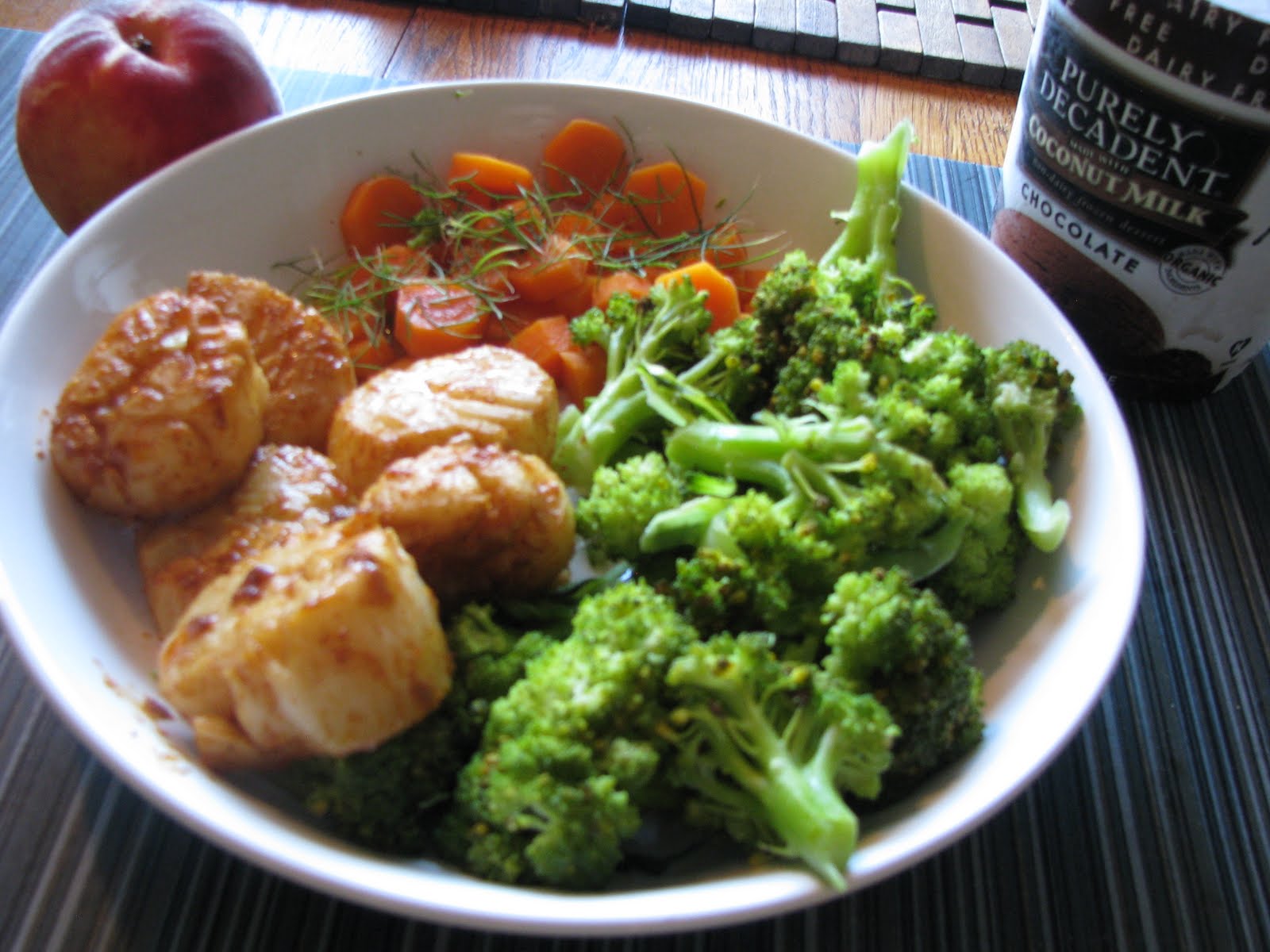
Delicious dinner last night
Sea scallops, broccoli, carrots (seasoned with fresh dill and honey), a local organic peach, and coconut milk ice cream (non dairy).
Yum!
Yum!
Friday, August 20, 2010
The Paleo Diet cures Depression?
I just read a story about a woman who "beat Depression" by changing her diet to a basic form of the Paleo Diet: no wheat, dairy, caffeine, or corn.
Here is a link to the article on MSN.com: How I Beat Depression and Weight Gain
I hadn't thought much about my mental health and how the Paleo Diet can help it b/c I don't have any major mental health problems, but I do know that this diet generally just makes me feel better. I would be interested to hear if someone I know with Depression went on the Paleo Diet and if it made a difference in their mental health.
I do know that an "extemporaneous" part of the Paleo Diet - exercise - really, really helps my mental health. When I am feeling stressed or anxious, if I just get a good, hard workout in I feel "cured." And really, that is part of the Paleo lifestyle so it can't be separated from what is known as the Paleo Diet.
One last thing: I have been learning that chocolate makes me feel bad. I've tried eating dark chocolate (without dairy) but I still don't feel great afterwards. I think this is one thing I need to work on eliminating from my diet. Wondering if there is something comparable I could replace it with that is Paleo-friendly?
Here is a link to the article on MSN.com: How I Beat Depression and Weight Gain
I hadn't thought much about my mental health and how the Paleo Diet can help it b/c I don't have any major mental health problems, but I do know that this diet generally just makes me feel better. I would be interested to hear if someone I know with Depression went on the Paleo Diet and if it made a difference in their mental health.
I do know that an "extemporaneous" part of the Paleo Diet - exercise - really, really helps my mental health. When I am feeling stressed or anxious, if I just get a good, hard workout in I feel "cured." And really, that is part of the Paleo lifestyle so it can't be separated from what is known as the Paleo Diet.
One last thing: I have been learning that chocolate makes me feel bad. I've tried eating dark chocolate (without dairy) but I still don't feel great afterwards. I think this is one thing I need to work on eliminating from my diet. Wondering if there is something comparable I could replace it with that is Paleo-friendly?
Wednesday, August 11, 2010
Non-pump A1c at 7.1%
I took an "insulin pump holiday" this summer so the infusion sites on my stomach could heal up a bit. Also, I wanted to see how my A1c would compare on the pump vs. shots while I did the Paleo Diet.
My last A1c (while on an insulin pump and eating Paleo) was 6.2%.
My current A1c (while doing shots and eating Paleo) was 7.1%.
So the pump seems to be better for my blood sugars than shots. I will say that I have done more "cheating" this summer, however, than when I first had my A1c measured so it is not an entirely direct cause-and-effect relationship.
An A1c of 7.0% is really the standard benchmark: if you are below this, you have a much lower risk of complications. And a "normal" person typically has an A1c below 6.0%. Diabetics with A1cs below 6.0% say that they are part of the "5% Club," which is what I aspire to. So I am going back on the insulin pump in about 1 month, and going to see if I can get myself below 6%.
My last A1c (while on an insulin pump and eating Paleo) was 6.2%.
My current A1c (while doing shots and eating Paleo) was 7.1%.
So the pump seems to be better for my blood sugars than shots. I will say that I have done more "cheating" this summer, however, than when I first had my A1c measured so it is not an entirely direct cause-and-effect relationship.
An A1c of 7.0% is really the standard benchmark: if you are below this, you have a much lower risk of complications. And a "normal" person typically has an A1c below 6.0%. Diabetics with A1cs below 6.0% say that they are part of the "5% Club," which is what I aspire to. So I am going back on the insulin pump in about 1 month, and going to see if I can get myself below 6%.
Wednesday, August 04, 2010
Coconut Bliss Paleo "ice cream"
Just discovered a great, mostly Paleo, summer treat! Coconut Bliss "ice cream." I bought the Chocolate Hazelnut Fudge flavor at Vitamin Cottage today and it is DELICIOUS! Even better than many (dairy) ice creams I've had! Here's a picture of happy me :)

Coconut Bliss is gluten, dairy, and refined-sugar free. It is made with coconut milk and agave nectar so I imagine it has a lower glycemic index than most ice creams made with sugar. And it tastes fantastic!
Monday, July 12, 2010
Local, organic, Paleo dinner
Sorry it's been a while! But here is a picture of our delicious dinner tonight, Paleo-friendly and almost all made from our CSA share: egg drop soup (eggs and green onions from CSA), peas, cherries, apricots, and apple cider!

We also had some chicken sausage but that was from the grocery store so I didn't include it in the photo above.

We also had some chicken sausage but that was from the grocery store so I didn't include it in the photo above.
Wednesday, June 02, 2010
Organic Go Take A Hike Trail Mix

I just found this gem of a Paleo trail mix at Vitamin Cottage this week! Organic Go Take A Hike Trail Mix. It's got cashews, golden raisins, mulberries, pistachios, goji berries (good for yin...), and cacao nibs. And the Vitamin Cottage brand was only around $3 for a 10 oz. bag! It was delicious on the 6 mile hike I took on Memorial Day.
Subscribe to:
Posts (Atom)
